I recently received a Fulbright Research grant to study aging and cognition, this entry dives deeper into the potential and impact of this project.
Humans have always offloaded thinking to tools: notes, calendars, maps. LLMs take up reasoning itself, and it’s unclear whether these tools assist or erode cognition due to overreliance.
This project studies how older adults adopt and use generative AI in everyday life, through participatory co-design sessions and a three-month feasibility study at Charité in Berlin.
What if cognitive offloading (Risko & Gilbert, 2016) could assist healthy aging through maintaining independence and improving quality of life in a meaningful way?
Would the system assist in decisions under load, or create overreliance?
When people hand off a decision, do they decide better, or do they stop checking?
Example of such decisions would be to help a user interpret an official letter, plan a trip across the city, or turn a recipe into a structured shopping list.
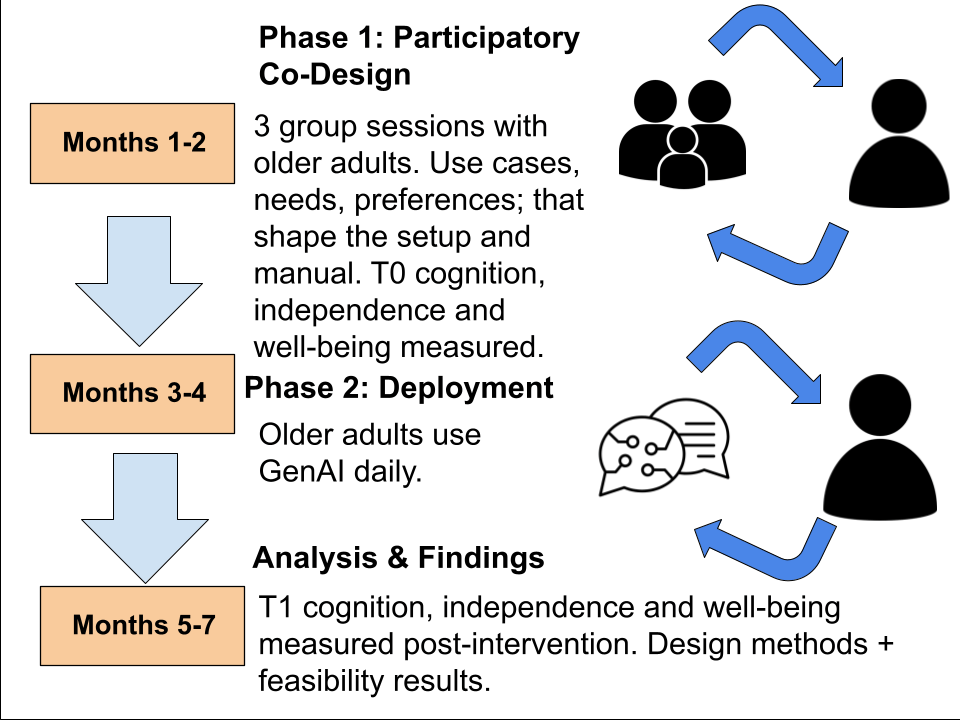
Figure 1 – Study Timeline (me)
This project is part of my Fulbright research; views are my own.
Sources:
Fang M, Hu J, Weiss J, Knopman DS, Albert M, Windham BG, Walker KA, Sharrett AR, Gottesman RF, Lutsey PL, Mosley T, Selvin E, Coresh J. Lifetime risk and projected burden of dementia. Nat Med. 2025 Mar;31(3):772-776. doi: 10.1038/s41591-024-03340-9. Epub 2025 Jan 13. PMID: 39806070; PMCID: PMC12305800.
Risko EF, Gilbert SJ. Cognitive Offloading. Trends Cogn Sci. 2016 Sep;20(9):676-688. doi: 10.1016/j.tics.2016.07.002. Epub 2016 Aug 16. PMID: 27542527.

